Hairdresser
Your path to opening your own hair salon in Switzerland
This comprehensive guide accompanies you on the path to opening your own hair salon in Switzerland. From qualifications and the L-GAV collective agreement to business formation and training apprentices, we cover all the important topics.
Opening your own hair salon is a big and rewarding step. The hairdressing trade in Switzerland has some particularities, especially the generally binding collective labor agreement (L-GAV) that you need to know. Here's your roadmap:
- Phase 1 (1-2 months): Check qualifications, choose legal structure and register business, understand L-GAV requirements.
- Phase 2 (2-4 months): Register for social insurance and pension fund, take out insurance, find salon location and sign lease.
- Phase 3 (2-3 months): Set up and equip salon, build team (if planned), build marketing and website.
- Phase 4 (1 month): Prepare opening, win first clients, start operations.
- Phase 5 (ongoing): Continuing education, apprentice training (optional), optimize business.
Plan for 4-8 months total, depending on whether you're taking over an existing salon (faster) or starting from scratch. Taking over an existing salon can be a smart option: you inherit an established client base, employees, and finished infrastructure.
The L-GAV (national collective labor agreement) is a central topic because it is generally binding and applies to all employers in the hairdressing trade. More on this in the "L-GAV" section.
In the hairdressing trade, qualifications play a central role. Here are the key diplomas:
EFZ Coiffeur/Coiffeuse: The federal basic training lasts 3 years and is the standard professional qualification. The EFZ covers all core competencies such as cutting, coloring, styling, and client consultation. Information can be found on berufsberatung.ch.
Master Hairdresser HFP (Advanced Federal Examination): The highest qualification in the hairdressing trade. With the master title, you're authorized to train apprentices (after completing the vocational trainer course) and demonstrate the highest professional competence.
Can I open a salon without an EFZ? In principle yes, but with a restriction: If you don't have an EFZ or equivalent qualification, you must employ a person with a master hairdresser title. A specific business permit is not required in most cantons.
coiffureSUISSE: The industry association is your most important contact. coiffureSUISSE represents industry interests, offers continuing education, provides forms and template contracts, and is a contracting party of the L-GAV. Membership offers numerous benefits, including legal advice, discounted insurance, and access to a strong network.
Useful Links
The L-GAV (national collective labor agreement) for the hairdressing trade is a central topic you absolutely need to understand. It is generally binding, meaning it applies to all employers in the hairdressing trade, regardless of whether you're a member of coiffureSUISSE or not.
Key provisions:
- Minimum wages: The L-GAV sets binding minimum wages, graduated by education and experience. Current amounts can be found on the Joint Commission's website.
- Working hours: Maximum weekly working hours, break regulations, and overtime rules are clearly defined.
- Holidays: The L-GAV sets minimum vacation days, which may exceed the legal minimum.
- 13th month salary: The L-GAV regulates the entitlement to the 13th month salary.
Joint Commission: The PK Coiffure monitors compliance with the L-GAV. It can conduct inspections and impose sanctions for violations. Contributions to PK Coiffure are shared equally between employers and employees.
coiffureSUISSE membership: Even though the L-GAV applies to everyone, membership in coiffureSUISSE offers concrete benefits: You receive support in correctly implementing the L-GAV, template contracts, legal advice, and discounted continuing education.
Tip: Thoroughly inform yourself about the current L-GAV before hiring employees. Mistakes in implementation can be expensive.
The choice of legal structure for a hair salon depends heavily on whether you plan to hire employees:
Sole proprietorship: Simple and inexpensive to set up. Ideal if you work alone or only occasionally employ temporary help. Registration in the commercial register is mandatory once annual revenue exceeds CHF 100,000. You're liable with your personal assets.
GmbH (recommended with employees): If you plan to hire employees from the start, a GmbH is recommended. Limited liability protects your personal assets. Minimum share capital is CHF 20,000. Formation costs (notary, commercial register) are approximately CHF 2,000-3,000.
For a salon with employees, we recommend the GmbH, as liability risks in an employer relationship (L-GAV obligations, social insurance for employees, lease agreement) are significantly higher than in solo self-employment. The GmbH provides you with an important shield of protection.
Don't forget: Regardless of legal structure, you must register as an employer with the AHV compensation office, BVG pension fund, accident insurance, and possibly the family compensation fund.
Useful Links
Social insurance is particularly relevant in the hairdressing trade, as an employer you're also responsible for your employees' insurance:
AHV/IV/EO (1st pillar): As a self-employed person, you register with the cantonal compensation office. If you have employees, you must also remit their AHV/IV/EO contributions (shared equally between employer and employee). Employer contributions are approximately 5.3% of gross salary.
Occupational pension (2nd pillar / BVG): BVG insurance is mandatory for your employees (above an annual salary of CHF 22,680). You must choose a BVG pension fund and cover at least half of the contributions as the employer. For yourself as the owner, BVG insurance is voluntary.
Accident insurance (UVG): Accident insurance is mandatory for employees. You must cover both occupational accidents (BU) and non-occupational accidents (NBU). BU premiums are borne by you as the employer; NBU premiums can be passed on to employees.
Family allowances (FAK): As an employer, you're obligated to pay family allowances. Register with your canton's family compensation fund.
Useful Links
In a hair salon, there are specific risks you should cover with the right insurances:
Professional liability insurance: Protects you from damage claims if your treatments cause harm. For hair salons, premiums start at approximately CHF 450 per year. Ensure an adequate coverage amount.
Specific risks in the hairdressing trade:
- Allergic reactions to hair dye: One of the most common risks. PPD (paraphenylenediamine) in hair color can trigger severe allergic reactions.
- Hair and scalp damage: From wrong products, excessive processing time, or faulty treatments.
- Burns: From hair dryers, flat irons, or chemical products.
Business insurance: If you rent a salon, you should take out business contents insurance to protect your furnishings, equipment, and inventory against fire, water, theft, and natural damage.
Legal protection insurance: Can be useful, especially if you have employees and employment law disputes cannot be ruled out.
In a hair salon, strict hygiene and safety standards apply to protect your clients and your team:
ChemV (Chemicals Ordinance): Hair dyes, perming solutions, and other products are subject to the Chemicals Ordinance. You must ensure correct application and keep safety data sheets for all products. The Chemical Notification Authority (anmeldestelle.admin.ch) provides information about regulations.
Tool disinfection and sterilization:
- Disinfect combs, brushes, and scissors after every client
- Properly dispose of razor blades and single-use materials after use
- Wash towels and capes after every use
Allergy documentation: There is no legal requirement to perform an allergy test (patch test) before coloring, but it is strongly recommended. coiffureSUISSE provides consent forms that protect you in case of damage. Carefully document your clients' allergy information.
Wastewater: Hair dyes and chemicals must not enter the wastewater system uncontrolled. Check with your municipal administration about specific requirements.
Recycling: Hair can be recycled! recuphair.ch collects hair clippings and uses them to produce oil absorbers. A sustainable initiative that also resonates well with your clients.
Administration of a hair salon is more extensive than in some other beauty professions, especially if you have employees:
Business account: A separate business account is essential, especially when paying salaries. Compare offerings from Migros Bank, UBS, Raiffeisen, and PostFinance. Look for integrated payroll processing options.
Payroll: With employees, payroll becomes a regular obligation. You must correctly process social insurance contributions, create pay slips, and remit withholding tax (if applicable). Tools like Bexio or Klara offer integrated payroll solutions for Swiss SMEs.
Online booking system: A professional booking tool is essential for a modern salon. Treatwell and coif.ch are specifically designed for the hairdressing industry. They offer appointment booking, client management, reminders, and analytics.
Point of sale system: Invest in a modern POS system with a card terminal. Most clients today pay by card or smartphone. Make sure the system can also process tips, as this is common in the hairdressing industry.
Setting up your salon is one of the biggest investments. Plan carefully and budget generously:
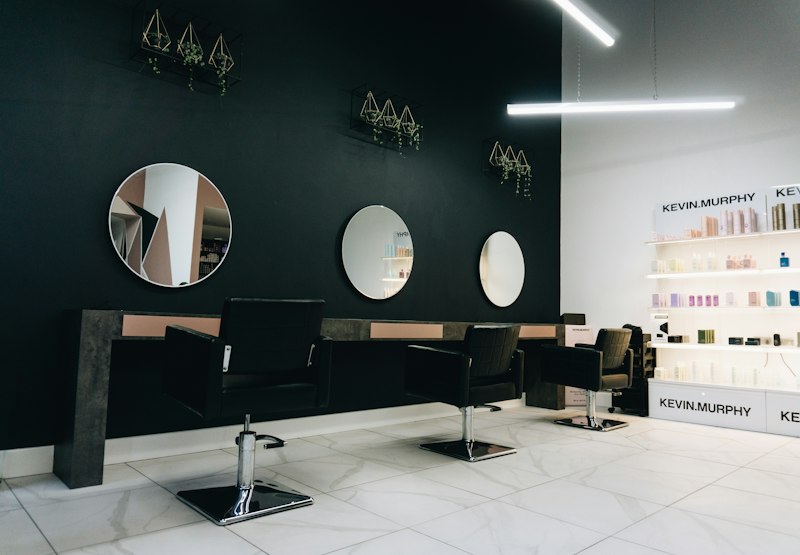
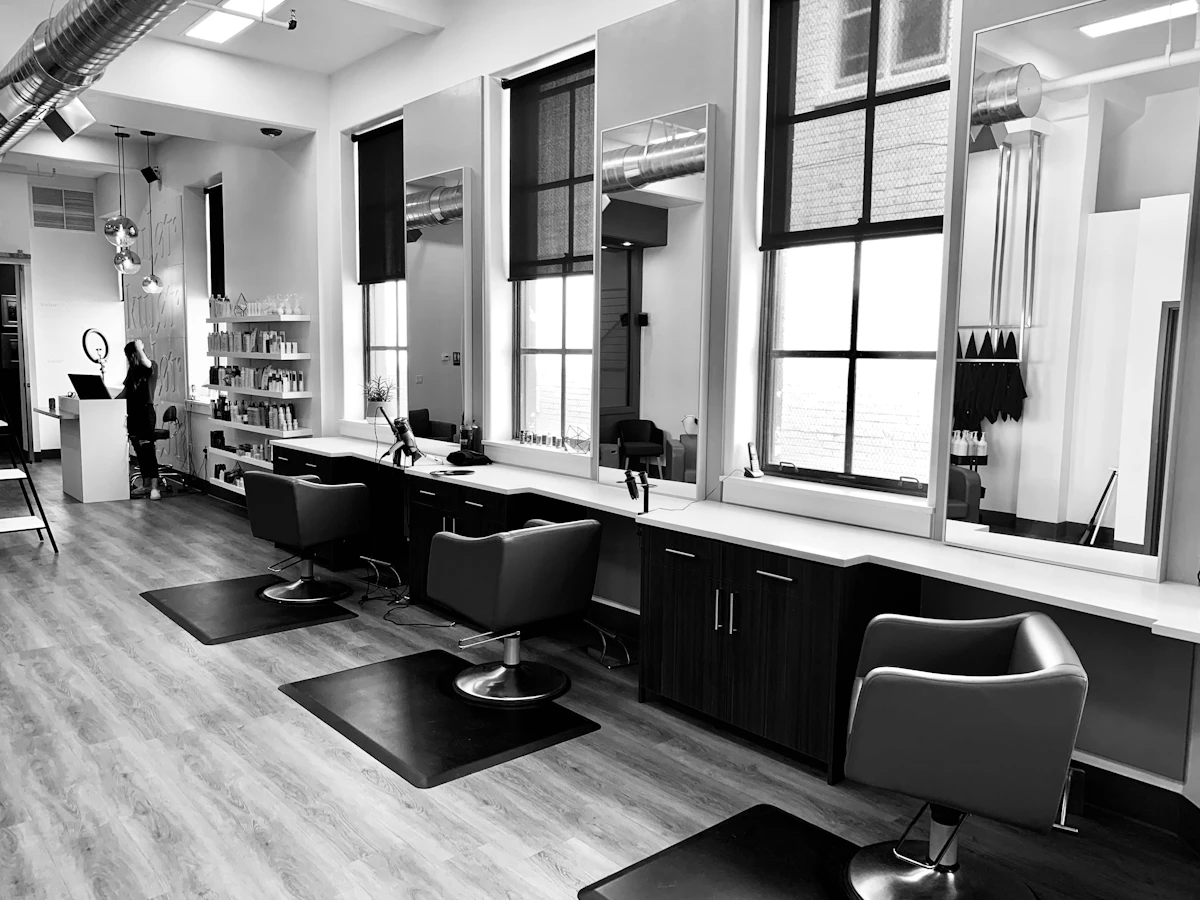
Location: For a hair salon, location is crucial. Walk-in clients can be an important revenue factor. Look for good visibility, accessibility by public transport and car, and adequate parking. A shop window facing the street is worth its weight in gold.
Basic equipment:
- Salon chairs (approximately CHF 500-2,000 per chair)
- Wash stations with backwash basins (approximately CHF 1,000-3,000 per station)
- Mirrors and workstations
- Hair dryers, flat irons, curling irons (professional quality)
- Color mixing station and product storage area
- Reception desk and waiting area
- Coat storage for clients
Ventilation: Good ventilation is mandatory, as hair dyes and chemical products release fumes. A professional ventilation system protects you, your team, and your clients.
Tip: The total investment for a medium-sized salon (3-4 workstations) typically ranges between CHF 50,000 and CHF 150,000, including furnishing, renovation, and initial product stock. When taking over an existing salon, this amount can be significantly lower.
Good marketing makes the difference between a full and an empty salon. Here are the key channels:
Website and branding: Your professional presence starts online. smedium specializes in web design and marketing for self-employed professionals in the beauty industry and helps you from the first idea to the finished online presence. A thoughtful brand, from logo to interior design to website, creates recognition that retains clients.
Instagram: Show before-and-after photos (with consent), share styling tips, and give behind-the-scenes insights. Collaborations with local influencers can quickly increase your reach.
Google Business Profile: Essential for local discoverability. Maintain your profile with current photos, opening hours, and services. Actively collect Google reviews from satisfied clients.
Platforms and directories:
- Treatwell: Leading booking portal for beauty in Switzerland
- coif.ch: Industry-specific directory and booking platform
- coiffeurvergleich.ch: Comparison platform for hair salons
- coiffureSUISSE salon finder: Industry association directory
- local.ch and Google Maps
Training apprentices is a rewarding task and strengthens your salon at the same time. However, there are clear prerequisites:
Requirements for vocational trainers:
- You must hold an EFZ (Federal Certificate of Competence) as a Coiffeur/Coiffeuse
- You need at least 3 years of professional experience after the EFZ
- You must have successfully completed the vocational trainer course (approximately 40 hours, offered by coiffureSUISSE and cantonal vocational education offices)
The vocational trainer course: This course teaches you the pedagogical and legal foundations for training apprentices. It covers topics such as apprenticeship contract law, training planning, working with young people, and quality assurance. coiffureSUISSE regularly offers courses.
Benefits of training apprentices:
- You train your own future talent
- Apprentices support salon operations
- You pass on your knowledge and contribute to the industry
- Image advantage: Training companies enjoy high reputation in Switzerland
Note: As a training company, you will be inspected by the cantonal vocational education office. Ensure you comply with training requirements and provide your apprentices with high-quality education.
Useful Links
You're ready to open your own salon! Here's your checklist:
- Check qualifications (EFZ present? Master hairdresser needed?)
- Study the L-GAV thoroughly
- Choose legal structure (GmbH recommended with employees)
- Register business and sign up for AHV
- Set up social insurance for yourself and employees
- Take out professional liability and business insurance
- Find salon location and review lease
- Set up and equip salon
- Open business account, set up POS and booking system
- Build website and marketing
- Consider coiffureSUISSE membership
- Celebrate opening and welcome first clients
Some of these steps can be tackled in parallel, while others build on each other. Don't be intimidated by the number of tasks. Set priorities and work through them step by step.
Need support with your website, branding, or digital marketing? smedium is your partner for a professional online presence. From your salon website to social media to Google Business Profile, smedium helps you become visible online and win clients.
Useful Links
Free PDF Guide
Get all the information as a clear PDF guide to print and reference.
Need a website, branding, or marketing?
smedium helps self-employed professionals with professional web design, branding, and digital marketing. From idea to finished online presence.
Get in touch